Test test test
One San Mateo Home
COVID-19 Resources / Recursos Relacionados a COVID-19
We are One San Mateo. Our dream is one San Mateo—a city of, by, and for all its people.
Who We Are
We are a community coalition working for a fair & inclusive San Mateo.
What You Can Do
The San Mateo Housing Stories Project
Giving a voice to the voiceless in the conversations around housing.
News You Can Use
An alternative but reliable source for news you can use.
Information & Resources
A place to learn and find answers.
Change Language / Cambiar Idioma / 改變語言 / …
Giving a voice to the voiceless in the conversations around housing.
The San Mateo Housing Stories Project is an ongoing project of One San Mateo.
Far too often, those affected most by changes in our communities are those who leaset have a voice in the matter. They lack a voice in the media, and they lack a voice in politics, one feeding the other in a vicious cycle.
Again and again, we hear powerful interests say that we lack the data to take action on housing. But then when we push for government to collect the relevant data, those very same powerful interests do an about-face and cynically stand in the way of the collection of data.
Only government can collect the necessary data on the full extent and nature of the housing problems we are suffering from. However, we will not standby and allow those affected by housing to be silenced by the inaction of others.
The San Mateo Housing Stories Project is aimed at gathering stories from and providing a forum for those being impacted by the continuing housing crisis. You are not alone. By raising our voices together we have power.

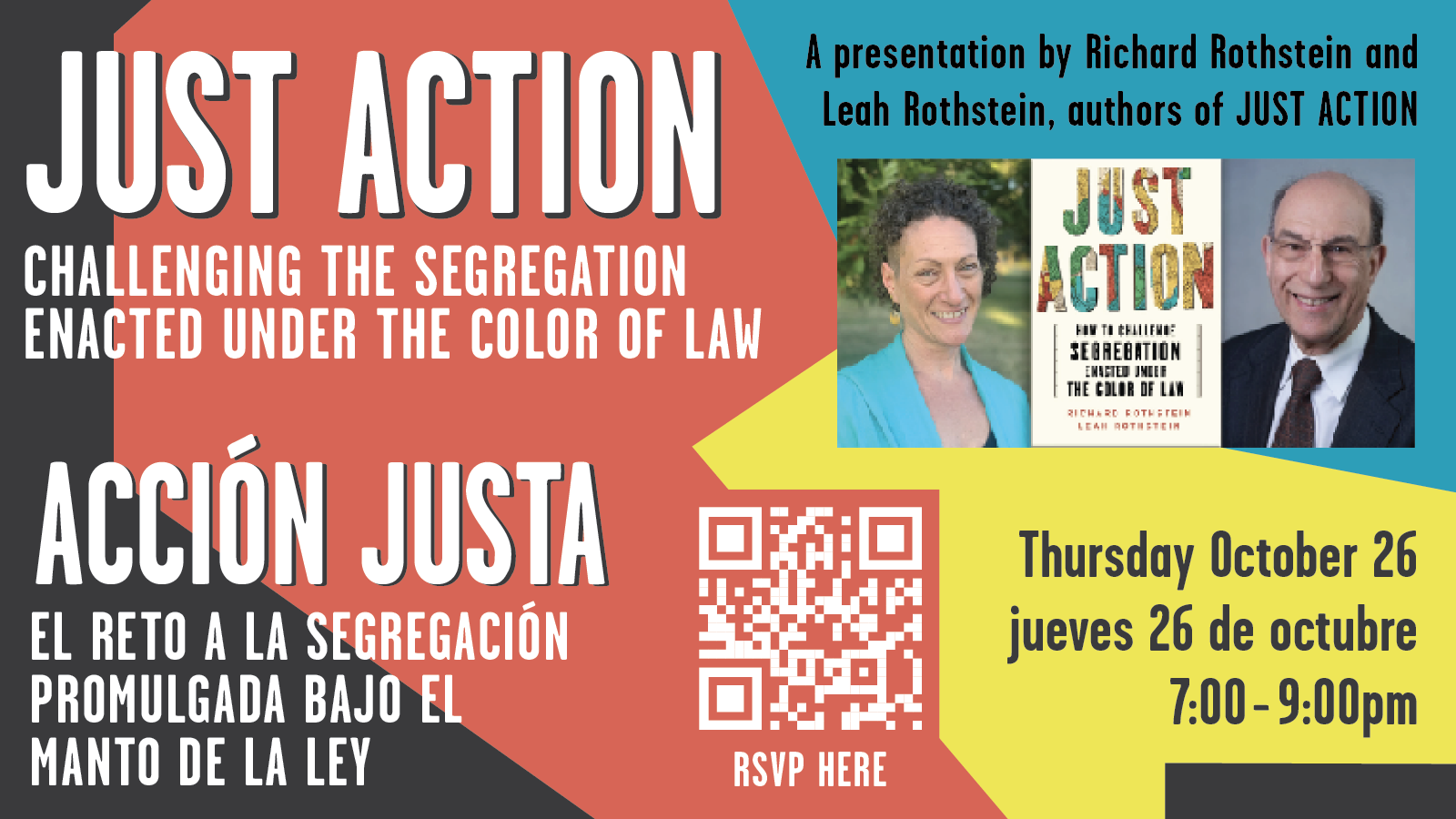
Back in the fall of 2019, Richard Rothstein, author of the bestselling book The Color of Law, delivered an address to a standing room-only crowd at the Congregational Church of San Mateo (CCSM). With nearly 400 community members in attendance, he described how government at all levels—national, state and local—acted to segregate our communities and prevent all but whites from owning homes.
On October 26, 2023 Richard Rothstein returns to San Mateo, accompanied this time by his daughter and housing policy expert Leah Rothstein. Together they will discuss how concerned community members can act to undo the harms of this history and remedy a profoundly unconstitutional aspect of our nation’s past. The name of the event is Just Action, which is also the title of a book the two of them have co-authored, just released in June. The evening’s program will also feature examples of work being done locally to achieve the ends that are the focus of the event.
The event will take place from 7 to 9 pm on Thursday, October 26, and will again be hosted by the Congregational Church of San Mateo, located at 225 Tilton Avenue in San Mateo. The program will include a Q&A period and be followed by a brief reception in the CCSM community hall.
The financial sponsor for this event is the San Mateo Anti-Displacement Coalition. Organizations involved in the planning include One San Mateo, Menlo Together, Housing Leadership Council, NAACP, the Peninsula Solidarity Cohort, Peninsula for Everyone, Pacifica Housing for all, and the social action ministries at St. Bart’s Parish and St. Matthews’ Catholic Church.
The registration link for the upcoming Just Action event is now available here: bit.ly/47aNaFR
Flyers and other materials for the event can be found below:


By Leora Tanjuatco Ross
(Originally appeared here in the San Mateo Daily Journal)
“I cannot live this way. I need help.” I received this text message two weeks ago, from a woman who lives in Daly City with her 84-year-old mother and twin daughters, who are in high school. In the simplest of ways, she needed relief. She explained to me that piecing together the rent every month was getting more and more difficult. It was nearing the impossible. She was at the end of her rope.
This story is a common one, particularly in the Bay Area. But this time, our federal and state governments have stepped in to help.
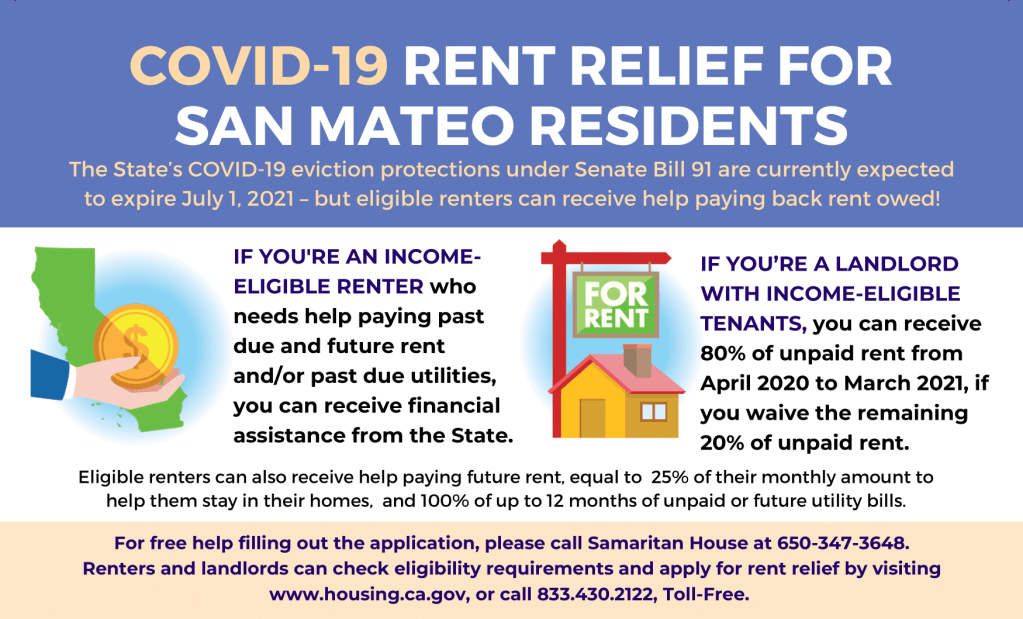
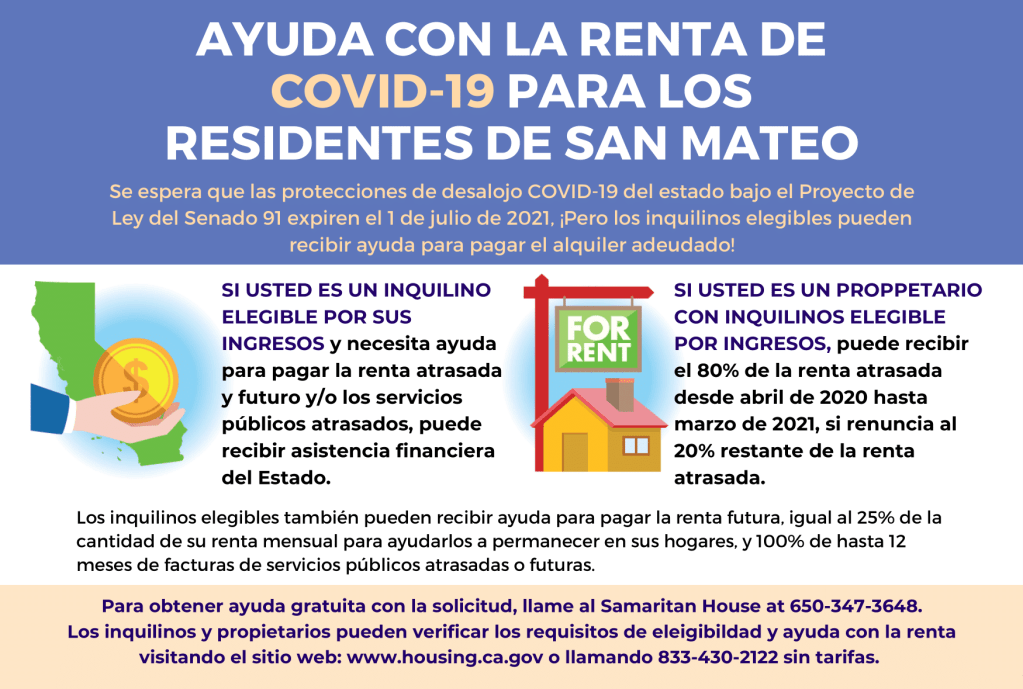
In January of this year, the California Legislature passed Senate Bill 91, which makes creative use of federal stimulus money to address the pressures experienced by both renters and landlords over the past year. In the face of illness and jobs lost due to COVID, many renters have been unable to pay their full rent and are now seriously in arrears, sometimes to the tune of tens of thousands of dollars. At the same time, their landlords have faced the loss of their customary revenue stream, putting some of them at risk of losing their investment properties. In response to these pressures, the state approved the use of $2.6 billion of federal stimulus money to backfill the missed rent. For San Mateo County alone, $75 million in rent relief funding is available.
The outlines of the program are simple:
1). If landlords agree to forgive 20% of the rent that went unpaid for the period from April 1, 2020, to March 31, 2021, the state will pay them the other 80%.
2). Assuming the landlord takes the state up on its offer, the tenant is then permanently relieved of the full amount of the accumulated debt.
However, almost five months after the state allocated this money, only 1% of the available funds have been distributed. For people who are precariously housed, this money is the only thing preventing them from homelessness.
In our outreach, we discovered that many members of the community are still completely unaware of this generous rent relief program. According to County Manager Mike Callagy, of the $75 million in rent relief funding available, less than a third has even been requested to date. In North County, leaders from Faith in Action Bay Area have been phone banking and have now made 719 calls to small landlords. Of those they have talked to, 86% did not know about the program. Meanwhile, 88% had tenants who had been unable to pay full rent during the pandemic. Clearly, there is widespread need that these funds could help to fill.
This rent relief program has the potential to be a high-impact win-win that brings life-changing relief to both landlords and tenants. But first they must learn about it.
Help us spread the word: Are you a small landlord yourself? Do you know of landlords in your congregations, workplaces or service clubs? Do you have neighbors who are landlords? If so, please encourage them to investigate this novel program of relief.
Are you a community leader or an elected official? Please help us spread the word about this program. Tell your friends, neighbors and networks. If you’re an elected official, please ask your city to send out a mailer with the information about this program, as Redwood City recently has done.
Most importantly, we call upon San Mateo County to use its considerable resources to get the word out about SB 91. Pull out the stops. An aggressive outreach effort will help to prevent a tsunami of homelessness that easily could overcome our community in the near future. In the effort to increase utilization of this high-impact program, county leadership is key.
There are resources for tenants and landlords. Faith in Action Bay Area is offering to help landlords with the application process. To access this help, please contact abby@faithinactionba.org. Other local organizations involved in providing assistance are Samaritan House, Project Sentinel, Nuestra Casa de East Palo Alto, and International Rescue Committee. To apply for this relief and for more information, including details on which tenants are eligible, please visit https://housingiskey.com.
Even if landlords do not apply, tenants can apply to receive 25% of rent debt for the same period of April 1, 2020, to March 31, 2021. Renters wanting more information are encouraged to email onesanmateo@onesanmateo.org or to contact one of the other organizations listed above.
Leora Tanjuatco Rossis the associate director of the Housing Leadership Council of San Mateo County.

As you may have heard, the Mercy nuns are proposing to develop their campus on Adeline Drive in Burlingame. Their current vision includes retirement housing for the nuns and a separate structure with senior affordable housing.
It is no surprise that they are encountering pushback from the “comfortably housed.” We are forwarding a link to a petition that is being circulated to show support for this project. Peninsula For Everyone is one of the petition sponsors.
Anyone who’s a supporter of affordable housing can sign this petition. Please consider adding your name!
By Justin Alley
The Bay Area is more racially segregated today than it was in 1970. Among the many destructive problems with residential segregation, one is that it helps governments create major imbalances in where they invest resources.
Broadly speaking, governments tend to invest more in whiter, wealthier neighborhoods. As a result, you often see more parks, schools and clean air in those areas. Meanwhile, governments tend to invest much less in predominantly Black, indigenous and Latinx neighborhoods. Residents of color have seen the problem worsening over time and are not surprised that Bay Area suburbs are increasingly segregated along racial and economic lines. The skyrocketing prices of homes in the suburbs during the pandemic are part of that disturbing trend.
Last month, the Association of Bay Area Governments nudged the region closer to the inclusive and prosperous place it claims to be. It adopted a draft regional plan that requires more affordability in the suburbs than it ever has before. The plan is called the Regional Housing Needs Allocation, or RHNA. It is a state-mandated planning process where regional agencies tell their cities and counties how much new housing, and at which income levels, they must plan for over an eight-year period. It is worth noting that this process does not tell cities precisely where they must put new housing. Therefore, it is incumbent upon cities to break the historical trend of trying to squeeze as much new housing into poorer, less-white neighborhoods, and instead distribute it equitably across the whole of the city.
The pressures are mounting and it is long overdue for cities to redress their zoning practices. Bay Area cities and counties were expecting to see higher housing targets this time compared to previous rounds. In June 2020, the state found that the Bay Area’s total housing target for 2023-2031 is more than double the target from last time. One major reason for this large increase is that the new target includes the thousands of homes the Bay Area failed to plan for in previous rounds. Now, all of our cities and counties have an urgent duty to pull their weight.
The new legal duty to Affirmatively Further Fair Housing adds another weight to the scale. It requires regional and local housing plans to actively increase fair housing choice for everyone, no matter their race, gender or other protected characteristic. Fair housing choice exists when households “have the information, opportunity and options to live where they choose without unlawful discrimination and other barriers related to race, color, religion, sex, familial status, national origin or disability.”
On the Peninsula, fair housing choice means having more affordable options in suburbs like San Bruno and San Mateo. These cities are known for having high-quality resources but few homes affordable to predominantly Black and brown low-income families. Only the wealthiest, who are disproportionately white, can benefit from these resources.
San Bruno currently has only one home affordable to every seven low-wage workers. San Mateo has one home affordable to every 10 low-wage workers. Many cities on the Peninsula, like Atherton and Hillsborough, have ignored fair housing choice by denying apartment buildings altogether. In the COVID-era, this is a wake-up call because a lack of affordable housing often leads to overcrowded houses and apartments.
We can do better.
Prior to the pandemic, 550,000 people were commuting every day to jobs on the Peninsula outside their home cities — that’s equivalent to three-quarters of San Mateo County’s entire population. Many commuters would prefer living in the city where they work, if they could afford it. And while many white-collar workers have been able to make the shift to working from home, this has not been the case for low-wage workers. When families can live close to work, stay in neighborhoods they grew up in, or afford to stay close to the people and resources they need, it is better for everyone — less traffic, more social cohesion, more time for families to spend with their children, and it moves us closer to the diverse and prosperous place we all want the Peninsula to be.
Now is the time for the Peninsula’s cities and counties to get to work and decide how they will meet these long overdue housing needs. Their decisions can ensure that every family who seeks to live here, whether for jobs, school or health, can find a place to call home. The Peninsula can do this, and we will all be stronger for it.
This piece originally appeared here in the San Mateo Daily Journal.
Please take a moment to watch this powerful video about the extreme hardships currently facing renters in San Mateo. Renters need decisive action to help them deal with the long and difficult road ahead of them.

The eviction cliff is rapidly approaching, and many of our neighbors are at risk. With the statewide eviction moratorium set to expire on January 31, thousands of Bay Area families face the very real danger of being forced from their homes.
One San Mateo is joining the effort of the faith community to prevent this, and we ask you for your support. Please participate in the call-in campaign now underway to persuade state legislators to vote in favor of two bills that have been proposed.
- AB 15 extends the moratorium originally put into place by AB 3088 until the end of 2021, protecting tenants from eviction as long as they pay a designated portion of their rent
- AB 16 is intended to address the long-term impacts of the pandemic on tenants, small landlords and affordable housing providers
The links below will take you to talking points and connect you with the office of your state legislators:
You can also have the links sent to your phone by texting NOEVICTIONS to 40649.
This request is especially urgent since the moratorium is due to expire very soon. Please call right away and help keep our neighbors in their homes.
Thank you!
Hi all,
As you are certainly aware at this point, the COVID crisis has put enormous pressure on lower income members of the community, many of whom have had their hours reduced or are completely without work. They struggle to feed their families, pay their utility bills, and meet their rent. In an effort to address these hardships, concerned politicians at all levels have worked to develop various forms of relief.
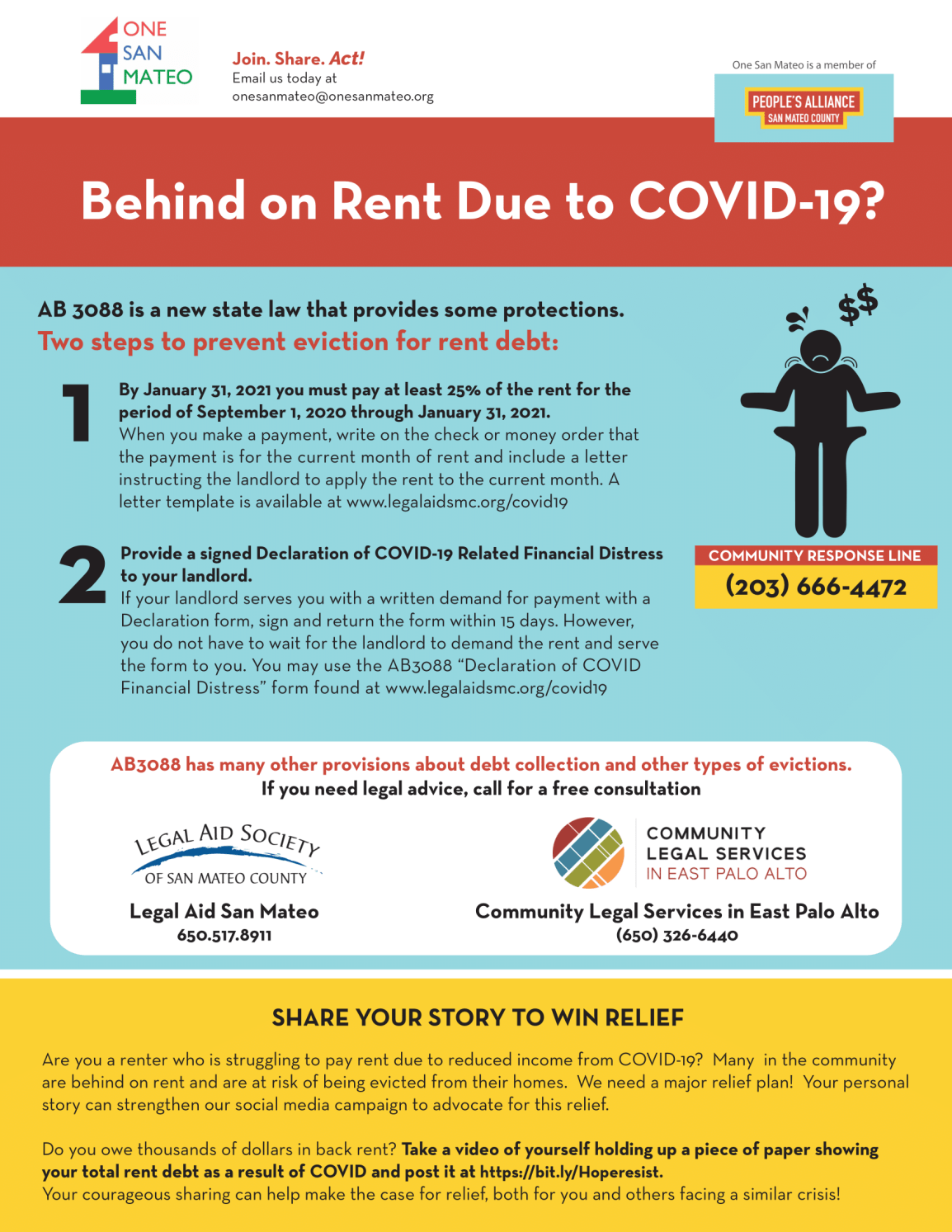
One of the more innovative forms of relief, embodied in California’s AB 3088, is the conversion of rent debt to civil debt, otherwise referred to as non-evictable debt. This is debt that is still owed to the landlord but cannot serve as the basis for eviction. If the rent remains unpaid, landlords can seek to recover it, but this can only be done through standard collection procedures, such as filing an action in small claims court.
Specifically, AB 3088 says that for the period March 1, 2020 through January 31, 2021, a major portion of unpaid rent is eligible to be converted to civil debt, provided that tenants pay a specified fraction of the rent that is due and fill out a form indicating that the nonpayment of rent is caused by pressures arising from the COVID pandemic.
In recent weeks, One San Mateo, acting on behalf of the People’s Alliance of San Mateo County (PASMC), has overseen the creation and distribution of a mailer to 4,000 low-income renter households in San Mateo to make them aware of the protections afforded by AB 3088. A copy of this mailer in both English and Spanish is attached. Similar mailers have been sent to 14,000 households in other cities in San Mateo County bearing the logo of allied organizations that are also members of PASMC.
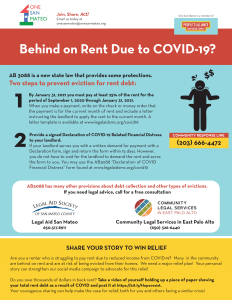
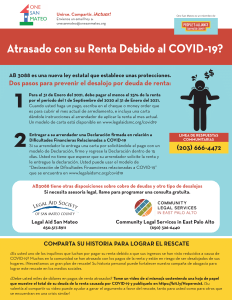
AB 3088 provided important relief, but under its terms, tenants will be required to pay 100 percent of their rent beginning on February 1, 2021 or else be subject to eviction from their homes. With the virus continuing to rage and businesses shut down again, this date is alarmingly close, and the prospect of widespread eviction becomes exceedingly real. Undocumented families are at special risk of eviction since they have been eligible for neither unemployment benefits nor stimulus checks.
In the coming weeks, One San Mateo and its allies will be examining possible options for extending relief measures to keep renters in their homes. I hope you will join us in making the case for this relief. In the midst of the current pandemic, it would be unconscionable to allow thousands of families to be forced from their homes.
Finally at year’s end, a word of thanks. On behalf of One San Mateo, I want to express my deep gratitude to the many of you who have extended financial and volunteer help to your neighbors over the past months, who have raised your voices to protest against systemic racism, and who cast your votes in favor of a more inclusive community this fall. While 2020 has been an undeniably difficult year, there is still much we can be thankful for. I ardently hope that we are.
Sincerely,
Karyl Eldridge
Vice Chair of One San Mateo

If you share One San Mateo’s views about some of the issues on the ballot this election, then here are some great ways you can get involved to make a difference before election day.
Locally
For Amourence Lee for San Mateo City Council:
https://www.amourencelee.com/get-involved
For Chelsea Bonini for San Mateo County Board of Education:
https://www.chelseabonini.com/volunteer
For No on Measure Y:
https://www.noonmeasurey.com/volunteer/
For Yes on Measure RR:
https://actionnetwork.org/forms/i-pledge-to-support-measure-rr-to-save-and-improve-caltrain-service
At the State Level
For Yes on Proposition 15:
https://www.yes15.org/volunteer
https://www.evolve-ca.org/phonebanking
For Yes on Proposition 17:
https://yeson17.vote/take-action/
 One San Mateo